

Weather Live°
Mosaic Srl
Weather apps are easy to judge when the sky is clear: open one, glance at the temperature, and move on. The real test comes when I am leaving home in a hurry, travelling through an unfamiliar area, or trying to decide whether a short outdoor plan is worth the risk. Weather Live° is built for those moments, combining forecasts, a weather map, and alerts in one mobile experience. After spending time with it, I found that its biggest strength is not simply showing weather information, but presenting several ways to check the same situation quickly.
That convenience comes with an important condition: the experience is closely tied to connectivity. Forecasts, map views, and changing conditions are most useful when the app can reach current information. When the connection is weak, the app becomes less dependable as a live decision-making tool, so I learned to treat it as a practical companion rather than an unquestionable authority. That distinction matters if you use weather information for commuting, travel, exercise, or outdoor work.
How Weather Live° feels in everyday use
The app comes from Mosaic Srl and sits in the weather category, with a free starting point that makes it easy to try without committing money immediately. Its age rating is Everyone, so the interface is suitable for a broad audience, including families who want a straightforward way to check conditions. The current release is version 7.8.6 and it runs on devices using Android 7.0 or later.
Related News

AccuWeather: Revolutionizing Mobile Meteorology
Why the Weather App is Your Go-To for Accurate Forecasts

Windy.com - Transforming Weather Forecasting with Stunning Precision
What I like first is the sense of having more than one weather view available. A normal forecast answers the obvious question—what should I expect where I am?—while the map helps with the more useful follow-up: is the weather changing nearby, and is that change moving toward me? Alerts add another layer by drawing attention to conditions that may deserve more than a casual glance.
The app has clearly found a large audience. It has passed 50 million installs, carries a 4.4 average from about 928 thousand ratings, and has roughly 30 thousand written reviews. Those figures do not guarantee that every forecast will suit every location, but they do suggest that the basic workflow is understandable enough for many people to return to it regularly.
Related News

Instagram Is No Longer a Photo App. It Is an Attention Engine

Microsoft Teams Mobile: When Collaboration Becomes Navigation

How the NFL App Adapts to Android and iOS Updates

Temu: Elevate Your Shopping Experience to Billionaire Status

Why Traffic Rider Works Best as a Precision Reflex Game

How Google’s Find Hub Transforms Everyday Searches
I would describe the design as better suited to people who want a visual weather check than to someone who only wants a tiny temperature number in a notification area. The map is especially useful when I am thinking in terms of movement rather than a single address. For example, before travelling across town, I can use the local forecast for the destination and then look at the wider pattern instead of assuming that conditions are identical along the whole route.
Connectivity is part of the experience
The most important practical lesson is that Weather Live° feels strongest when it can refresh information. A forecast is time-sensitive by nature, and a map is even more dependent on current data. If I open the app while connected, the experience feels immediate: I can check the local outlook, inspect the broader weather picture, and pay attention to alerts in one session.
That changes in places with unreliable mobile service. A train journey through patchy coverage, an underground station, a rural road, or a crowded event can turn a quick weather check into a waiting exercise. I would not plan a long hike or a day of outdoor work on the assumption that the app will always provide a fresh view when I need it. The safer habit is to check conditions before entering a weak-signal area and to keep an eye on official local guidance when conditions may become serious.
Gallery
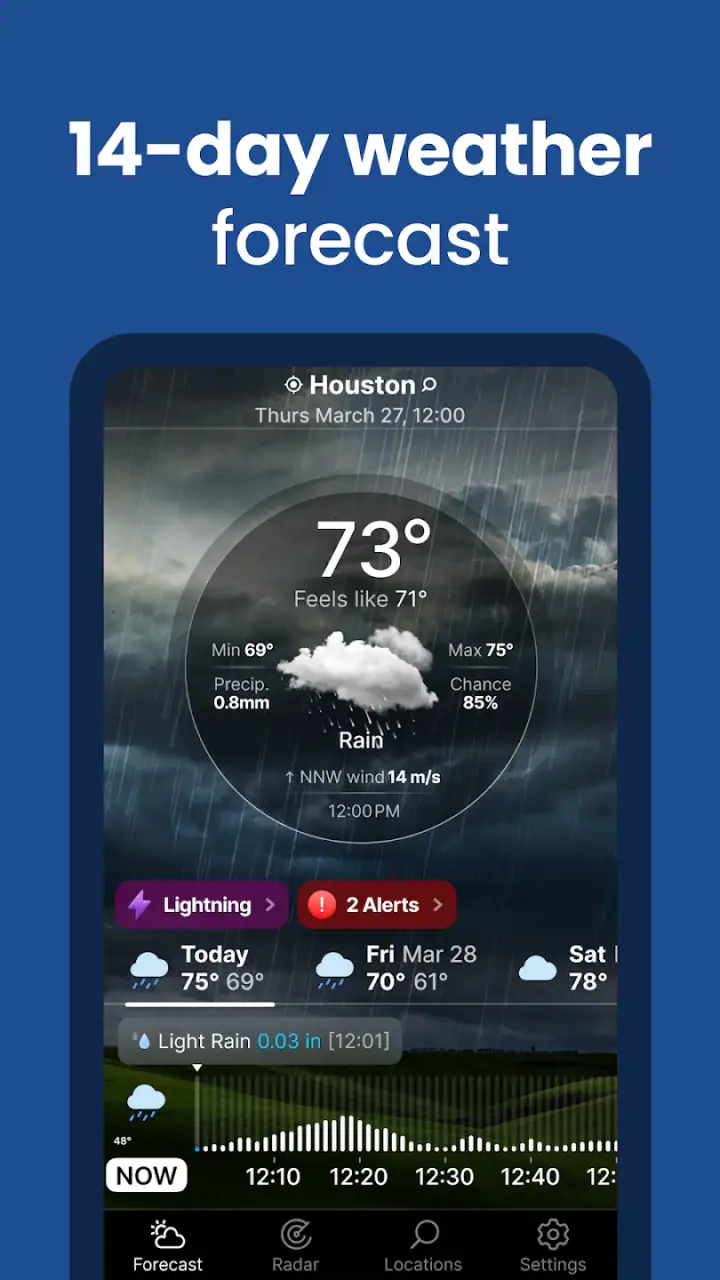
This does not make the app unusual; most live weather services face the same limitation. The difference is that Weather Live° encourages a richer, more visual style of checking, so the loss of connectivity can feel more noticeable than it would in a minimal app that only displays a previously loaded temperature. The more you rely on maps and alerts, the more important your connection becomes.
I also found that connectivity affects attention. When the app is able to refresh smoothly, it supports quick decisions. When it is repeatedly trying to update, the user may spend too long waiting for a view that is already becoming outdated. In that situation, I prefer to make a conservative choice rather than keep refreshing. Weather information is useful, but no app can remove uncertainty from a changing atmosphere.
Useful on the move, not just at home
Weather Live° makes the most sense on a phone because weather decisions often happen between places. I might check it while getting ready for work, then look again before leaving a café, and once more before walking home. That repeated, mobile pattern is where the combination of forecast, map, and alerts earns its place.
A realistic example is a weekend market visit. In the morning, I can check whether the general outlook supports going. Before leaving, I can inspect the map to see whether a band of poor weather is approaching. If an alert appears later, it gives me a reason to reassess rather than blindly follow the original plan. The useful workflow is not “open once and trust forever”; it is “check before the decision, then recheck when the situation changes.”
For commuting, the map can be more informative than a single daily summary. A person travelling across a city may encounter different conditions at the departure point and destination. The visual view encourages me to think about the route as a moving line through changing weather, which is a small but meaningful improvement over checking only the weather icon for one saved location.
Travellers should still use some discipline. Before leaving a reliable connection, I would review the forecast for the places I expect to visit and note any important warnings. I would not assume that a map view alone tells me whether roads, trails, airports, or public transport are operating normally. Weather information helps with planning, but it is not a replacement for transport updates or local safety instructions.
The app is also a reasonable choice for people who dislike overly technical weather dashboards. You can begin with a simple question—what is it like outside?—and only move to the map or alerts when you need more context. That layered approach keeps the first glance approachable while leaving room for more careful checking.
What happens when a refresh fails
Every weather app needs a sensible response to uncertainty, and this is where I think users should develop their own routine. If a refresh does not complete, I do not treat the last visible information as a guarantee. I check whether the connection is working, try again later, and compare the situation with what I can observe outside. A darkening sky, strong wind, or sudden temperature change deserves attention even if the screen has not updated.
The app’s alerts are most valuable when they support that habit rather than replace it. An alert can prompt me to look again, but I still want to understand what is happening before changing plans. For a short walk, a delayed update may be a minor inconvenience. For cycling, boating, outdoor labour, or travel in severe conditions, it becomes a reason to use additional sources and leave more margin for error.
One practical recovery method is to separate the problem into two questions. First, is the app failing to load because the phone has weak connectivity? Second, is the weather itself changing quickly enough that any forecast needs cautious interpretation? Solving the first may require moving to a better signal or waiting, while solving the second requires a more conservative decision. Treating both as the same problem can lead to false confidence.
I also recommend checking the app before the moment of need. If I know I will be outside for hours, I would rather review the forecast while connected than wait until I am already standing in a location where the network is unreliable. This is not an offline promise; it is simply good preparation for a service whose live information depends on communication with its data source.
Compared with a very basic weather widget, Weather Live° gives me more ways to investigate a questionable forecast. Compared with a specialised meteorological service, it may feel less focused on technical detail and professional analysis. That trade-off is reasonable for everyday users, but people making high-stakes decisions should not confuse a polished consumer interface with a complete forecasting system.
Keeping mobile use sensible
Because the app includes detailed views and a weather map, I would be mindful of how often I open it on a limited mobile plan. I cannot promise a particular amount of data use, since that depends on how frequently you refresh, how long you spend viewing maps, and how the phone handles network content. Still, the practical approach is obvious: use a normal forecast for quick checks and reserve the map for moments when the broader picture genuinely helps.
This also saves battery and attention, even without measuring either one. A short glance is more efficient than leaving a detailed visual view open while doing something else. If I am simply deciding between a jacket and a light layer, I do not need to study every available view. If I am planning a long trip or outdoor activity, the extra context becomes more worthwhile.
People with limited connectivity should make the app part of a pre-trip routine. Check the destination, examine the wider conditions, review alerts, and then avoid assuming that the same information will always be available later. This is especially important when moving between countries or remote areas, where network access may be inconsistent or costly. The app remains useful in that situation, but the user has to plan around its live nature.
The free entry point is another reason to try it, although in-app purchases range from $0.99 to $81.99 per item. I would begin by deciding whether the free experience already covers my normal weather checks before considering any purchase. That approach prevents the common mistake of paying for extra convenience before knowing whether the app fits my habits. The price range also means users should look carefully at what a purchase provides and whether it solves a real problem for them.
For someone who wants a completely stripped-down experience with minimal visual content, the map and alert-oriented approach may feel like more than necessary. A built-in phone weather panel can be faster for a one-second glance. On the other hand, those simpler alternatives may not offer the same combination of broader visual context and dedicated weather checking. The better choice depends on whether you regularly ask only “what is the temperature?” or also “what is moving toward my route?”
Who will appreciate it most
I think Weather Live° is a strong fit for people who make frequent short-term plans around the weather. Commuters, parents organising outdoor time, casual runners, travellers, and anyone who checks conditions several times a day can benefit from the combination of local forecasts, map-based context, and alerts. It is also approachable for users who do not want to learn specialised weather terminology before getting useful information.
It is less suitable as the only source for decisions where mistakes could be dangerous. Outdoor professionals, pilots, sailors, emergency planners, and people heading into remote terrain should use more specialised and official information as well. The app can be a convenient additional view, but convenience is not the same as authority.
I would also hesitate to recommend it to someone who has very limited data or spends most of the day without reliable connectivity. The experience is shaped around current information, and the map makes that dependency more visible. A lightweight service that loads a simple forecast quickly may be a better everyday fit for that person, especially if their main need is a basic glance rather than exploration.
For most casual users, though, the learning curve is modest. Start with the local forecast, use the map when planning movement, and treat alerts as prompts to reassess. That three-step routine captures the app’s value without encouraging endless checking. The best weather app is not the one that keeps me staring at the screen; it is the one that helps me make a sensible decision and put the phone away.
My final view on staying connected
After using Weather Live°, I see it as a polished everyday weather companion with a clear visual advantage. Its detailed forecast, weather map, and alerts work together well when I have a dependable connection and want more context than a single icon can provide. The app is free to start, broadly accessible, and established enough to have attracted over 50 million installs, while its 4.4 average shows generally positive reception from a substantial user base.
My main reservation is not about the idea of the app, but about expectations. A live weather service cannot be treated as equally useful in every network situation, and a map-heavy workflow makes that limitation more apparent. I would check it before travelling, use it intelligently on mobile data, and avoid relying on one delayed screen when conditions matter.
My recommendation is simple: choose Weather Live° if you want weather information that supports movement and changing plans, not just a static temperature. It is particularly good for the everyday scenario of checking, reassessing, and checking again as the day develops. If you need a minimal widget, a highly technical forecasting tool, or dependable guidance in a high-risk environment, another option may suit you better. For ordinary planning, however, its connected approach gives me enough useful context to recommend trying it.
In the end, the app works best when I treat connectivity as part of the tool rather than an invisible detail. With a good signal, Weather Live° turns a quick forecast into a more informed picture of the conditions around me. With a poor signal, preparation and common sense become just as important as the app itself.
FAQs for Weather Live°
What features does Weather Live° offer?
Weather Live° provides real-time weather updates, detailed forecasts, and customizable weather widgets. Users can access hourly and weekly forecasts, view weather maps, and receive notifications for severe weather alerts. The app also includes sunrise and sunset times, atmospheric pressure readings, and UV index data to keep you informed.
Is Weather Live° accurate and reliable?
Weather Live° uses data from multiple reliable sources to ensure accuracy. It provides up-to-date information on local weather conditions and forecasts. Users often find the app's predictions consistent and dependable for planning daily activities, though it's always wise to cross-reference with other sources during severe weather events.
Is Weather Live° free to use, or does it require a subscription?
Weather Live° offers a free version with basic features and ad support. For an ad-free experience and access to premium features, such as extended forecasts and additional customization options, users can opt for a subscription. The app often offers a free trial period for new subscribers to explore premium features.
Can I customize the notifications in Weather Live°?
Yes, you can customize notifications in Weather Live° to suit your preferences. Users can choose to receive alerts for severe weather, daily forecasts, and temperature changes. The app allows you to set notification preferences for specific locations, ensuring you receive timely updates relevant to your area.
Does Weather Live° support multiple locations?
Weather Live° supports multiple locations, allowing users to monitor weather conditions in various areas. This feature is particularly useful for travelers or those who want to keep track of weather conditions in different cities. You can easily switch between locations and receive tailored forecasts for each area.
Pros
- User-friendly interface with intuitive navigation.
- Highly accurate weather forecasts.
- Customizable widgets enhance user experience.
- Detailed weather maps with real-time updates.
- Supports multiple locations for easy tracking.
Cons
- Ads can be intrusive in the free version.
- Frequent notifications may be overwhelming.
- Some features require a premium subscription.
- Occasional lag in updating weather data.
- Limited offline functionality.


